Saturday, 5 June 2021

Theatre of Absurd & Comedy of Menace


Hello readers...

This is the assignment of sem -2  of paper no.5 that is the History of English literature 1900 to 2000 . I had taken the topic of Theatre of absurd and Comedy of Menance.


⚫ Theatre of the Absurd,


The absurd theatre  dramatic works of certain European and American dramatists of the 1950s and early ’60s who agreed with the Existentialist philosopher Albert Camus’s assessment, in his essay “The Myth of Sisyphus” , that the human situation is essentially absurd, devoid of purpose. The term is also loosely applied to those dramatists and the production of those works. Though no formal Absurdist movement existed as such, dramatists as diverse as Samuel BeckettEugène IonescoJean GenetArthur AdamovHarold Pinter, and a few others shared a pessimistic vision of humanity struggling vainly to find a purpose and to control its fate. Humankind in this view is left feeling hopeless, bewildered, and anxious.
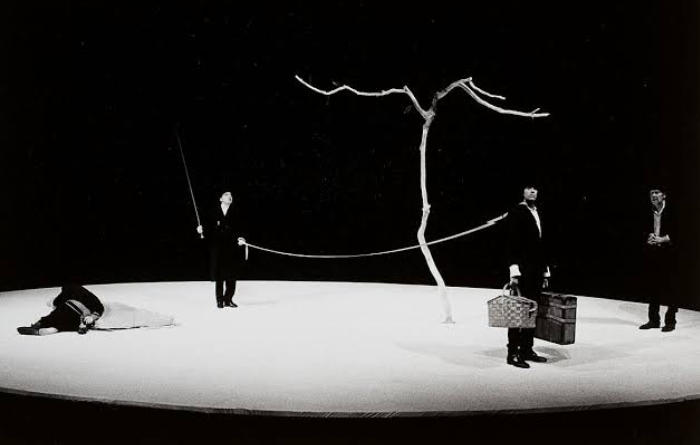


The ideas that inform the plays also dictate their structure. Absurdist playwrights, therefore, did away with most of the logical structures of traditional theatre. There is little dramatic action as conventionally understood; however frantically the characters perform, their busyness serves to underscore the fact that nothing happens to change their existence. In Beckett’s Waiting for Godot (1952), plot is eliminated, and a timeless, circular quality emerges as two lost creatures, usually played as tramps, spend their days waiting but without any certainty of whom they are waiting for or of whether he, or it, will ever come.


Language in an Absurdist play is often dislocated, full of cliches, puns, repetitions, and non sequiturs. The characters in Ionesco’s The Bald Soprano  sit and talk, repeating the obvious until it sounds like nonsense, thus revealing the inadequacies of verbal communication. The ridiculous, purposeless behaviour and talk give the plays a sometimes dazzling comic surface, but there is an underlying serious message of metaphysical distress. This reflects the influence of comic tradition drawn from such sources as commedia dell’arte, vaudeville, and music hall combined with such theatre arts as mime and acrobatics. At the same time, the impact of ideas as expressed by the Surrealist, Existentialist, and Expressionistschools and the writings of Franz Kafka is evident.


Originally shocking in its flouting of theatrical convention while popular for its apt expression of the preoccupations of the mid-20th century, the Theatre of the Absurd declined somewhat by the mid-1960s; some of its innovations had been absorbed into the mainstream of theatre even while serving to inspire further experiments. Some of the chief authors of the Absurd have sought new directions in their art, while others continue to work in the same vein.


⚫Comedy of menace


Comedy of menace is the body of plays written by David CamptonNigel DennisN. F. Simpson, and Harold Pinter. The term was coined by drama critic Irving Wardle, who borrowed it from the subtitle of Campton's play The Lunatic View: A Comedy of Menace, in reviewing Pinter's and Campton's plays in Encore in 1958. Campton's subtitle Comedy of Menace is a jocular play-on-words derived from comedy of manners menace being manners pronounced with somewhat of a Judeo-English accent.


Citing Wardle's original publications in Encore magazine (1958), Susan Hollis Merritt points out that in "Comedy of Menace" Wardle "first applies this label to Pinter's work describing Pinter as one of 'several playwrights who have been tentatively lumped together as the "non-naturalists" or "abstractionists". 

In "Comedy of Menace", as Merritt observes, on the basis of his experience of The Birthday Party and others' accounts of the other two plays, Wardle proposes that "Comedy enables the committed agents and victims of destruction to come on and off duty; to joke about the situation while oiling a revolver; to display absurd or endearing features behind their masks of implacable resolution; to meet in paper hats for a game of blind man's buff"; he suggests how "menace" in Pinter's plays "stands for something more substantial: destiny," and that destiny, "handled in this way not as an austere exercise in classicism, but as an incurable disease which one forgets about most of the time and whose lethal reminders may take the form of a joke is an apt dramatic motif for an age of conditioned behaviour in which orthodox man is a willing collaborator in his own destruction" .


After Wardle's retraction of comedy of menace as he had applied it to Pinter's writing, Pinter himself also occasionally disavowed it and questioned its relevance to his work  For example, in December 1971, in his interview with Pinter about Old Times, Mel Gussow recalled that "After The Homecoming said that couldn't any longer stay in the room with this bunch of people who opened doors and came in and went out.Landscape and Silence the two short poetic memory plays that were written between The Homecoming and Old Times are in a very different form. There isn't any menace at all.' 


Despite Wardle's retraction of comedy of menace ,Comedy of menace and comedies of menacecaught on and have been prevalent since the late 1950s in advertisements and in critical accounts, notices, and reviews to describe Pinter's early plays and some of his later work as well.As Merritt points out, among other examples of critics' usage of this and similar categories of Pinter's work, after Gussow's 1971 "conversation" with Pinter, "Though he echoes Wardle's concept, Gussow seems to avoid using comedy of menace when reviewing the CSC Repertory Theatre's 1988 production of The Birthday Party


💡The Birthday Party(1958)

In discussing the first production of Pinter's first full-length play, The Birthday Party (1958), which followed his first play, The Room (1957), his authorised official biographer Michael Billington points out that Wardle "once excellently" described its setting , as "a banal living-roomopens up to the horrors of modern history" .


💡The Dumb Waiter(1960)

In his second one-act play, The Dumb Waiter(1960), as accentuated through the 2008 film by Martin McDonaghclosely resembling and markedly influenced by it, In Bruges, "Pinter conveys the idea of political terror through the staccato rhythms of music-hall cross-talk and the urban thriller: Hackney Empire cross-fertilises with Hemingway's The Killers one of Pinter's own acknowledged early influences, along with Franz Kafka ,Elizabethan and Jacobean dramatists, such as William Shakespeare, John Webster, and Cyril Tourneur, whose work his schoolmaster Joseph Brearley had introduced to him; Samuel Beckett and black-and-white American movies of the 1940s and 1950s.


The "punning title" of The Dumb Waiter, Billington observes, "carries several layers of meaning": "It obviously refers to the antique serving-hatch that despatches [sic] ever more grotesque orders for food to these bickering gunmen" the dumbwaiter; "But it also applies to Gus, who, troubled by the nature of the mission [their next job as hitmen] to realise he is its chosen target; or, indeed to Ben, who, by his total obedience to a higher authority that forces him to eliminate his partner, exposes his own vulnerability" . As Gus "dumbly" awaits his fate, he may be a subservient partner who awaits orders from the "senior partner" Ben, but Ben too is subservient to The Powers That Be, a contemporary variation on Deus ex machina, manipulating both the mechanical dumbwaiter and them through its increasingly extravagant and thus comically inconvenient "orders" for increasingly exotic dishes, unnerving both of them.

Billington adds:

This being Pinter, the play has a metaphorical openness. You can interpret it as an Absurdist comedy  a kind of Godot in Birmingham about two men passing the time in a universe without meaning or purpose. You can see it as a cry of protest against a whimsically cruel God who treats man as His plaything even the twelve matches that are mysteriously pushed under the door have been invested with religious significance by critics. But it makes much more sense if seen as a play about the dynamics of power and the nature of partnership. Ben and Gus are both victims of some unseen authority and a surrogate married couple quarrelling, testing, talking past each otherand raking over old times. 


The comedy in this "comedy of menace" often derives from such arguments between Gus and Ben, especially the one that occurs when "Ben tells Gus to go and light the kettle," a "semantic nit-picking that is a standard part of music-hall comedy": "All the great stage and film double acts  Jewel and Warriss, Abbott and Costello fall into this kind of verbal worrying in which the bullying 'male' straight man issues instructions which are questioned by the more literal-minded 'female' partner" 

GUS: Light what?
BEN: The kettle.
GUS: You mean the gas.
BEN: Who does?
GUS: You do.
BEN: (his eyes narrowing): What do you mean, I mean the gas?
GUS: Well, that's what you mean, don't you? The gas.
BEN: (Powerfully): If I say go and light the kettle I mean go and light the kettle.
GUS: How can you light a kettle?

BEN: It's a figure of speech! Light the kettle. It's a figure of speech! 


As Billington observes further,

This kind of comic pedantry has precise echoes of the great Sid Field ironically since the city is the setting of this play a Birmingham comic who had a famous sketch in which he played a virgin of the greens being hectored by Jerry Desmonde's golf pro who would cry, in exasperation, 'When I say "Slowly Back" I don't mean "Slowly Back", I mean "Slowly Back." ' At another moment, the bullying pro would tell the hapless Sid to get behind the ball and he would vainly protest 'But it's behind all round it'. But, where in a music-hall sketch this kind of semantic by-play was its own justification, in Pinter it becomes a crucial part of the power-structure. … The pay-off comes when Gus, having dogmatically insisted that the accurate phrase is 'put on the kettle', suddenly finds an irritated Ben adopting the right usage. 

"Everything" in The Dumb Waiter, Billington observes, "contributes towards a necessary end"; for, "the image, as Pete says in The Dwarfs, stands in exact correspondence and relation to the idea" . In this example, the central image and central metaphor, the dumbwaiter, while "despatching ever more unlikely orders," serves as "both a visual gag and a metaphor for manipulative authority" , and therein lies its menace. When Ben instructs Gus verbally, while practicing their "routine" for killing their next victim, he leaves out the most important line, which instructs Gus to "take out" his "gun" .

"BEN frowns and presses his forehead.
GUS. You've missed something out.
BEN. I know. What?
GUS. I haven't taken my gun out, according to you.
BEN. You take your gun out
GUS. After I've closed the door.
BEN. After you've closed the door.
GUS. You've never missed that out before, you know that?


The crucial significance of the omission becomes clear only at the very end of the play, when "Gus enters through the door stage-right the one marked for the intended victim stripped of his gun and holster"; it becomes clear that he is going to be "Ben's target" as Ben's "revolver  levelled at the door", though the play ends before Ben fires any shot .


Thank you...

Tuesday, 1 June 2021

Northrop Frye'sThe Archetypal Criticism

Hello readers...

This is the assignment of sem -2  of paper no.4 that is the  Literary Theory & Criticism and  Indian Aesthetics . I had taken the topic of Northrop Frye's Archetypal Criticism.


Archetypal Criticism : A way of new criticism :


Archetypal theory and criticism, although often used synonymously with Myth theory and crticism, has a distinct history and process. The term “archetype” can be traced to Plato (arche, “original” “form”), but the concept gained currency in twentieth-century literary theory and criticism through the work of the Swiss founder of analytical psychology, C. G. Jung(1875-1961). Jung’s Psychology of the Unconscious appeared in English one year after publication of the concluding volume with bibliography of the third edition of J. G. Frazer’s The Golden Bough: A Study in Magic and Religion . Frazer’s and Jung’s texts formed the basis of two allied but ultimately different courses of influence on literary history.


Jung most frequently used “myth” (or “mythologem”) for the narrative expression, “on the ethnological level”, of the “archetypes,” which he described as patterns of psychic energy originating in the collective unconscious and finding their “most common and most normal” manifestation in dreams . Thus criticism evolving from his work is more accurately named “archetypal” and is quite distinct from “myth” criticism.

For Jung,


 “archetype is an explanatory paraphrase of the Platonic eidos” 


 but he distinguishes his concept and use of the term from that of philosophical idealism as being more empirical and less metaphysical, though most of his “empirical” data were dreams. In addition, he modified and extended his concept over the many decades of his professional life, often insisting that “archetype” named a process, a perspective, and not a content, although this flexibility was lost through the codifying, nominalizing tendencies of his followers.

At mid-century, Canadian critic Northrop Frye (1912-91) introduced new distinctions in literary criticism between myth and archetype. For Frye, as William K. Wimsatt and Cleanth Brooks put it, 


archetype, borrowed from Jung, means a primordial image, a part of the collective unconscious, the psychic residue of numberless experiences of the same kind, and thus part of the inherited response-pattern of the race” 


 Frye frequently acknowledged his debt to Jung, accepted some of Jung’s specifically named archetypes ” persona and anima and counsellor and shadow” and referred to his theory as Jungian criticism , a practice subsequently followed in some hand books of literary terms and histories of literary criticism, including one edited by Frye himself, which obscured crucial differences and contributed to the confusion in terminology reigning today. Frye, however, notably in Anatomy of Criticism, essentially redefined and relocated archetype on grounds that would remove him unequivocally from the ranks of “Jungian” critics by severing the connection between archetype and depth psychology: 


This emphasis on impersonal content has been developed by Jung and his school, where the communicability of archetypes is accounted for by a theory of a collective unconscious an unnecessary hypothesis in literary criticism, so far as I can judge” 


 Frye, then, first misinterprets Jungian theory by insisting on a Lamarckian view of genetic transmission of archetypes, which Jung explicitly rejected, and later settles on a concept of “archetype” as a literary occurrence per se, an exclusively intertextual recurring phenomenon resembling a convention .


On a general level, Jung’s and Frye’s theorizings about archetypes, however labeled, overlap, and boundaries are elusive, but in the disciplines of literature the two schools have largely ignored each other’s work. Myth criticism grew in part as a reaction to the formalism of New Criticism, while archetypal criticism based on Jung was never linked with any academic tradition and remained organically bound to its roots in depth psychology: the individual and collective psyche, dreams, and the analytic process. Further, myth critics, aligned with writers in comparative anthropology and philosophy, are said to include Frazer, Jessie Weston, Leslie Fiedler, Ernst Cassirer, Claude Lévi-Strauss, Richard Chase, Joseph Campbell, Philip Wheelwright, and Francis Fergusson. But Wheelwright, for example, barely mentions Jung   and he, Fergusson, and others often owe more to Sigmund Freud, Ernest Jones, Oedipus Rex, and the Oedipus complex than to anything taken from Jung. Indeed, myth criticism seems singularly unaffected by any of the archetypal theorists who have remained faithful to the origins and traditions of depth, especially analytical, psychology James Hill, Henri Corbin, Gilbert Durand, Rafael Lopez-Pedraza, Evangelos Christou. This article, then, treats the only form of literary theory and criticism consistent with and derived directly from the psychological principles advanced by Jung. Other forms previously labeled “Jungian” are here subsumed under the term “archetypal” because whatever their immediate specific focus, these forms operate on a set of assumptions derived from Jung and accept the depth-psychological structure posited by Jung. Further, Jung termed his own theory “analytical psychology,” as it is still known especially in Europe, but Jungian thought is more commonly referred to today in all disciplines as “archetypal psychology.”

The first systematic application of Jung’s ideas to literature was made in 1934 by Maud Bodkin in Archetypal Patterns in Poetry: “An attempt is here made to bring psychological analysis and reflection to bear upon the imaginative experience communicated by great poetry, and to examine those forms or patterns in which the universal forces of our nature there find objectification” . This book established the priority of interest in the archetypal over the mythological.

The next significant development in archetypal theory that affected literary studies grew out of the effort made by U.S.-born, Zurich-trained analyst James Hillman (b. 1924) 

to move beyond clinical inquiry within the consulting room of psychotherapy”

 to formulate archetypal theory as a multidisciplinary field (Archetypal 1). Hillman invokes Henri Corbin (1903-78), French scholar, philosopher, and mystic known for his work on Islam, as the “second father” of archetypal psychology. As Hillman puts it, Corbin’s insight that Jung’s “mundus archetypalis” is also the “mundus imaginalis” that corresponds to the Islamic “alam al-mithl” was an early move toward 

a reappraisal of psychology itself as an activity of poesis” .

 Hillman also discovers archetypal precursors in Neoplatonism, Heraclitus, Plotinus, Proclus, Marsilio Ficino, and Giambattista Vico. In Re-Visioning Psychology, the published text of his 1972 Yale Terry Lectures (1937), Hillman locates the archetypal neither “


"in the physiology of the brain, the structure of language, the organization of society, nor the analysis of behavior, but in the processes of imagination” 


Archetypal theory then took shape principally in the multidisciplinary journal refounded by Hillman in 1970 in Zurich, Spring: An Annual of Archetypal Psychology and Jungian Thought.  

These archetypalists, focusing on the imaginal’and making central the concept that in English they call “soul,” assert their kinship with Semiotics and Structuralism but maintain an insistent focus on psychoid phenomena, which they characterize as meaningful. Their discourse is conducted in poetic language; that is, their notions of “soul-making” come from the Romantics, especially William Blake and John Keats. 


By speaking of soul as a primary metaphor, rather than defining soul substantively and attempting to derive its ontological status from empirical demonstration or theological (metaphysical) argument, archetypal psychology recognizes that psychic reality is inextricably involved with rhetoric” .


This burgeoning theoretical movement and the generally unsatisfying nature of so much early “Jungian literary criticism” are both linked to the problematic nature of Jung’s own writing on literature, which comprises a handful of essays:

➡ “The Type Problem in Poetry,”

➡ “On the Relation of Analytical Psychology to Poetry,"

➡ “Psychology and Literature,” 

➡ “Ulysses: A Monologue,” and 

➡ “Is There a Freudian Type of Poetry?” 

These essays reveal Jung’s lack of awareness as a reader despite his sense that they

 “may show how ideas that play a considerable role in my work can be applied to literary material” 

 They also attest to his self-confessed lack of interest in literature:


 “I feel not naturally drawn to what one calls literature, but I am strangely attracted by genuine fiction, i.e., fantastical invention” 


 This explains his fascination with a text like Rider Haggard’s novel She: The History of an Adventure (1886-87), with its unmediated representation of the “anima.” As Jung himself noted: “Literary products of highly dubious merit are often of the greatest interest to the psychologist”. Jung was also more preoccupied with dreams and fantasies, because he saw them as exclusively (purely) products of the unconscious, in contrast to literature, which he oddly believed, citing Joyce’s Ulysses as an example, was created “in the full light of consciousness” 

Issues of genre, period, and language were ignored or subjected to gross generalization as Jung searched for universals in texts as disparate as the fourth-centuryShepherd of Hermas,the Divine Comedy,Francesco Colonna’s Hypnerotomachia Poliphili (1499), E. T. A. Hoffman’s tales, Pierre Benoit’s L’Atlantide(1919-20), and Henry Wadsworth Longfellow’s “Hiawatha,” as well as works by Carl Spitteler and William Blake. But the great literary text for Jung’s life and work was Johann Wolfgang von Goethe’sFaust, not because of its literary qualities but because he sensed that the drama expressed his own personal myth .Further, the text offered confirmation of the only direct contribution Jung made to literary theory: a distinction between “psychological” and “visionary” texts. This heuristic distinction was formed, however, solely on psychobiographical grounds: Did the text originate in, and remain principally shaped by, the author’s experience of consciousness and the personal unconscious or his or her experience at the level of the archetypal collective unconscious? And concomitantly, on which of these levels was the reader affected? Confirmation of this theory was Jung’s reading of Faust: part 1 was “psychological”; part 2, “visionary.”


Thus Jungian theory provided no clear avenue of access for those outside of psychology, and orthodox Jungians were left with little in the way of models for the psychological analysis of literature. Many fell prey to Jung’s idiosyncrasies as a reader, ranging widely and naively over genres, periods, and languages in search of the universal archetypes, while sweeping aside cultureand text-specific problems, ignoring their own role in the act of reading and basing critical evaluation solely on a text’s contribution to the advancement of the reader’s individuation process, a kind of literature-astherapy standard. This way of proceeding had the effect of putting, and keeping, archetypal criticism on the margins of academic discourse and outside the boundaries of traditional academic disciplines and departments.


Thank you...

Ernest Hemingway's "For Whom The Bell Tolls"


 Hello readers...

This is the assignment of sem -2  of paper no.3 that is the  American  literature . I had taken the topic Ernest Hemingway' For whom The Bell Tolls : Cultural connections.


➡ For whom the bell tolls : Cultural connections


For Whom the Bell Tolls, novel by Earnest Hemingway published in 1940. The title is from a sermon by John Donne containing the famous words

 "No man is an island, entire of itself every man is a piece of the Continent. Any man’s death diminishes me, for I am involved in mankind. Any therefore never send to know for whom the bell tolls it tolls for thee."


💡 Cultural connections :

For Whom the Bell Tolls is a distinctive work in part because Hemingway attempts to translate Spanish idioms and grammar directly, without removing their original contexts. The result is a novel that is acutely attuned to cultural differences. Instead of assimilating Spanish culture into a wholly American writing style, Hemingway combines the two, helping to express Spanish to an English-speaking audience. Similarly, Robert Jordan’s own experiences as an American fighting for the anti-fascist Spaniards reveal more resemblances between the two cultures than differences. The United States, Jordan discloses, is no less corrupt than Spain, and Jordan’s own allegiance toward the anti-fascists demonstrates the extent to which cultural differences can be transcended. Though Jordan initially believes that he cannot understand the Spanish people, whom he views as profoundly two-sided caught between extreme “kindness” and extreme “cruelty” he finds himself overcoming this conviction to form intense bonds with his fellow fighters, confirming the important of connection and empathy across cultures.


For Whom the Bell Tolls takes up the project of cross-cultural linguistics, attempting to depict the Spanish language in an American style without fully “Americanizing” its facets. Some dialogue in the novel reads as archaic or outdated, since Hemingway attempts to express the difference between formal and familiar addresses in Spanish.Hemingway’s translations are not always seamless or modern in feel, allowing the English-speaking reader to “hear” the linguistic differences between English and Spanish. Thus, English and Spanish are marked as distinct but uniquely intertwined, allowing for cross-cultural exchange at the level of language.

The novel also explores the impact of cross-cultural dynamics on its American protagonist and Spanish characters, drawing parallels between the political situations of both the United States and Spain, and developing Robert Jordan’s attachment to Spain throughout the novel. Robert Jordan wonders “what sort of guerrilla leader” Pablo“would have been in the American Civil War,” comparing his own knowledge of American warfare imparted on him by his grandfather, a veteran of the American Civil War with his impressions of the Spanish Civil War. American and Spanish violence, he realizes, are not so different. Prompted by Pilar’s story of Pablo’s massacre on the fascists in his hometown, Jordan reveals that he once witnessed a lynching in Ohio, incited by the same kind of drunkenness and mob behavior that took shape in Pablo’s town:


“I have had experiences which demonstrate that drunkenness is the same in my country. It is ugly and brutal.” 


Furthermore, Agustin, another guerrilla fighter, asks Jordan about taxes and land ownership in the United States, arguing that


 “the big proprietors and the rich will make a revolution against such taxes they will revolt against the government when they see that they are threatened, exactly as the fascists have done here,”


 and suggesting that the United States, like Spain, will soon confront fascism, given their shared problems.

At first, Jordan believes that there are few connections to be made between Spanish and American culture, despite his own immersion in Spanish culture and his former position as a Spanish teacher in the United States. Jordan declares that “there are no other countries like Spain,” and that “there is no finer and no worse people in the world” than the Spaniards, explaining that he does not understand them, because if he did, he “would forgive it all,” and he finds it difficult to forgive their brutality. Yet he also never feels “like a foreigner” in Spain, since the Spaniards trust his command of the language and his knowledge of different regions.

Ultimately, Jordan sacrifices himself for the safety of his fellow guerrillas, allowing them to escape to safety and devoting himself to the cause of the Republic: 


“he fought now in this war because it had started in a country that he loved and he believed in the Republic and that if it were destroyed life would be unbearable for all those people who believed in it.” 


In becoming a martyr, Jordan demonstrates his own understanding of and connection to the Spanish people, and he declares that “I have been all my life in these hills since I have been here. Anselmo is my oldest friend.Agustin, with his vile mouth, is my brother, and I never had a brother. Maria is my true love and wife.”

Though many of Hemingway’s novels and writings are set away from the United States such as A Farewell to Arms and The Sun Also Rises they usually feature a globalist perspective, drawing comparisons between an American home and a European setting. Cultural differences are likewise emphasized in For Whom the Bell Tolls, but these differences do not preclude the possibility of cultural connection or mutual understanding. 


💡 Love &war


Through the characters of Robert JordanMariaPilar, and Pablo in For Whom the Bell Tolls, Hemingway examines the role of love and relationships in a time of crisis. The two main relationships described between Jordan and Maria, and Pilar and Pablo differ dramatically: Jordan and Maria’s love is pure and all-consuming, while Pilar and Pablo argue frequently, with Pilar often threatening to kill Pablo and take over his position in the guerilla squad. Nonetheless, love is omnipresent in the midst of the chaos of civil war, with both positive and negative consequences for those who choose to love. Jordan  has never experienced love before he meets Maria, and his relationship with her affirms the value of trust and compassion between individuals, while Pilar’s relationship with Pablo reveals the extent to which love cannot cure hopelessness and fear in the face of war and impending disaster.


Maria serves as a symbol of hope, renewal, and tenderness, tending to Jordan and demonstrating the healing power of devotion. Though she is part of the guerilla fighters, Maria is barely involved in any of the strategizing or political discussions. Whereas Pilar is the clear leader of the group, fiercely devoted to the cause of liberation from Fascist command, Maria’s role is domestic, focused on assisting the fighters behind the scenes. This sense of helpfulness and docility extends into her relationship with Jordan, whom she views as her redeemer, capable of restoring her after her experience of rape at the hands of Falangists :


 “if I am to be thy woman I should please thee in all ways,” 


Maria tells Jordan, promising herself to him.


Ultimately, Jordan is injured in the final ambush at the bridge, leaving Maria to flee the fascist attackers, though he tells her that even in death, they are united: 

“there is no good-by, because we are not apart . I am with thee now. We are both there. Go!” 

Jordan’s love for Maria, and his desire to see her led to safety, lends him strength as he faces death, since while he cannot do anything for himself, he “can do something for another.”


Pablo eventually betrays the guerillas by stealing the detonation equipment necessary to destroy the bridge, despite Pilar’s attempts to regain control of the group and prevent her husband from sabotaging their plot. Though Pilar is a stabilizing, maternal force in the novel, encouraging Robert Jordan and the other guerillas to continue agitating for the Republic and constantly working to organize the group, her relationship with Pablo proves to be her weakness: Pilar is unable to manipulate Pablo into acting in the best interests of the group.

Faced with Pablo’s brash, impulsive behavior, 

“the woman of Pablo could feel her rage changing to sorrow and to a feeling of the thwarting of all hope and promise.”

 It is implied that Pilar and Pablo were once deeply connected by their belief in the Republic, but Pablo no longer feels the confidence that Pilar does. Though Pilar tells Robert Jordan about Pablo’s heroic defeat of the fascists in his hometown, the Pablo she now knows is defeated, disillusioned, and, in her opinion, “cowardly,” lacking all hope for victory. The remaining love she ostensibly shares for him since their marriage endures, despite rising tensions is not enough to restore his courage.

Whereas Maria and Robert Jordan’s relationship provides both characters with a sense of security and emotional support, even when death is imminent, Pablo and Pilar’s partnership is only one in name. Despite Pilar’s strength of character, neither she nor Pablo is able to support each other in the way that Maria and Robert Jordan are. The novel thus provides an ambivalent view of love, suggesting that intimate relationships are not always redeeming or positive; Maria and Robert Jordan’s relationship may merely be an outlier. However, though Pablo survives the war and Jordan does not, Jordan dies with the knowledge that he has experienced the emboldening effects of life-altering love, while Pablo must own up to his own moral failings.


Thank you...

Monday, 31 May 2021

Samuel Beckett's Waiting for the Godot

 Hello readers...

This is the assignment of sem -2  of paper no.2 that is the 20th century literature : from world war I to the end of the century . I had taken the topic of Human condition and Absurdism in the play.


🔎Waiting for Godot : Human condition and Absurdism


The play starts with the wo men, Vladimir and Estragon, meet near a tree. They converse on various topics and reveal that they are waiting there for a man named Godot. While they wait, two other men enter. Pozzo is on his way to the market to sell his slave, Lucky. He pauses for a while to converse with Vladimir and Estragon. Lucky entertains them by dancing and thinking, and Pozzo and Lucky leave.

After Pozzo and Lucky leave, a boy enters and tells Vladimir that he is a messenger from Godot. He tells Vladimir that Godot will not be coming tonight, but that he will surely come tomorrow. Vladimir asks him some questions about Godot and the boy departs. After his departure, Vladimir and Estragon decide to leave, but they do not move as the curtain falls.

The next night, Vladimir and Estragon again meet near the tree to wait for Godot. Lucky and Pozzo enter again, but this time Pozzo is blind and Lucky is dumb. Pozzo does not remember meeting the two men the night before. They leave and Vladimir and Estragon continue to wait.

Shortly after, the boy enters and once again tells Vladimir that Godot will not be coming. He insists that he did not speak to Vladimir yesterday. After he leaves, Estragon and Vladimir decide to leave, but again they do not move as the curtain falls, ending the play.


⚫ Human condition :


Estragon is trying to take off his boot when Vladimir enters. The two men greet each other; Vladimir examines his hat while Estragon struggles with his boot. They discuss the versions of the story of the two thieves in the Gospels, and Vladimir wonders why one version of the story is considered more accurate than the others.

Estragon wants to leave, but Vladimir tells him that they cannot because they are waiting for Godot, who they are supposed to meet by the tree. They wonder if they are waiting in the correct spot, or if it is even the correct day.

Estragon falls asleep, but Vladimir wakes him because he feels lonely. Estragon starts to tell Vladimir about the dream he was having, but Vladimir does not want to hear his "private nightmares." Estragon wonders if it would be better for them to part, but Vladimir insists that Estragon would not go far. They argue and Vladimir storms off the stage, but Estragon convinces him to come back and they make up.

They discuss what to do next while they wait, and Estragon suggests hanging themselves from the tree. However, after a discussion of the logistics, they decide to wait and see what Godot says.

Estragon is hungry, and Vladimir gives him a carrot. They discuss whether they are tied to Godot when they hear a terrible cry nearby and huddle together to await what is coming.


Concept revolving around human psyche : 


The beginning of the play establishes Vladimir and Estragon's relationship. Vladimir clearly realizes that Estragon is dependent on him when he tells Estragon that he would be "nothing more than a little heap of bones" without him. Vladimir also insists that Estragon would not go far if they parted. This dependency extends even to minute, everyday things, as Estragon cannot even take off his boot without help from Vladimir.

The beginning of the play makes Vladimir and Estragon seem interchangeable. For example, one of the characters often repeats a line that the other has previously said. This happens in the very beginning when the two characters switch lines in the dialogue, with each asking the other, "It hurts?" and responding, "Hurts! He wants to know if it hurts!" In addition to demonstrating the way that the two characters can be seen as interchangeable, this textual repetition will be found throughout the play as an indicator of the repetitiveness of life in general for Vladimir and Estragon.


Vladimir's discussion of the story of the two thieves brings up the question of textual uncertainty. He points out that the four gospels present entirely different versions of this story, and wonders why one of these versions is accepted as definitive. This question about the reliability of texts might cause the reader of this play to question the reliability of this particular text. Also, the repetition of the story by the four gospels might allude to the repetitiveness of the action of the play.

The repetitiveness of the play is best illustrated by Estragon's repeated requests to leave, which are followed each time by Vladimir telling him that they cannot leave because they are waiting for Godot. The exact repetition of the lines each time this dialogue appears, including the stage directions, reinforces the idea that the same actions occur over and over again and suggests that these actions happen more times than the play presents.


The play is thought to initiate a theatrical tradition called absurd drama. But like any other artistic puzzles, thetheatre of the absurd cannot be reduced to a single bottom line. It cannot be defined in a single word or by a particular theory. In order to understand the rise, characteristics and popularity of the absurd drama we must look back to the events that took place during the first half of the 20th century in the worlds of politics, literature, philosophy and religion. 

The early 20th century witnessed two World Wars .In literature it gave birth to two recognizable literary styles: modernism and post-modernism. In philosophy the rise of existentialism was the most important event and the world also saw the decline of men’s faith in religion. All these happenings paved the way for the theatrical tradition the absurd drama which in fact was a reflection the age. 


Absurdism : 

The group of the playwrights whose works came to be known as the absurd plays include Samuel Beckett, Eugene Ionescoe, Jean Genet, Edward Albee and Harold Pinter. These writers flout all the standards by which drama has been judged for many centuries. As playwrights they share some theatrical techniques and philosophic ideas. In their plays there is no particular attention spent developing a recognizable plot, no detailed characterization, and no readily definable theme. This bizarre rejection of any recognizable pattern or development gave birth to the term Literature of the Absurd. Philosophically almost all of them share the existentialist philosophy of absurdity and nothingness.


Beckett's Waiting for Godot largely deals with the absurd tradition. The play is without any plot, character, dialogue and setting in the traditional sense.

The setting of the play creates the absurdist mood. A desolate country road, a ditch, and a leafless tree make up the barren, otherworldly landscape whose only occupants are two homeless men who bumble and shuffle in a vaudevillian manner. There is a surplus of symbolism and thematic suggestion in this setting. The landscape is a symbol of a barren and fruitless civilization or life. There is nothing to be done and there appears to be no place better to depart. The tree, usually a symbol of life with its blossoms and fruit or its suggestion of spring, is apparently dead and lifeless. But it is also the place to which they believe this Godot has asked them to come. This could mean Godot wants the men to feel the infertility of their life. At the same time, it could simply mean they have found the wrong tree.


The setting of the play reminds us the post-war condition of the world which brought about uncertainties, despair, and new challenges to the all of mankind. A pessimistic outlook laced with sadism and tangible violence, as a rich dividend of the aftermath of wars. It is as if the poignancy and calamities of the wars found sharp reflections in Beckett’s Waiting for Godot.

Next comes the plot. In the traditional sense a plot should concentrate on a single motivated action and is also expected to have a beginning, a middle and a neatly tied-up ending. But it’s almost impossible to provide a conventional plot summary of Waiting for Godot, which has often been described as a play in which nothing happens. It is formless and not constructed on on any structural principles.


"Vladimir: Well, shall we go?
Estragon: Yes, let’s go.
They do not move"

In the raditional play is expected to entertain the audience with logically built,witty dialogue.But in this play,like any other absurd play,the dialogue seems to have degenarated into meaningless babble.The dialogues the characters exchange are meaningless banalities.

The absurd plays deal with the themes of existentialism, especially the existentialist theme of absurdity.The absurd playwrights tried to translate the contemporary existentialis philosophy into the drama. The absurd playwrights also tried to portray the distrassful condition of the humans.In Waiting for Godot the human condition is shown as a dismal and distressful state. The derelict man struggles to live or rather exist, in a hostile and uncaring world. A sense of stagnancy and bareness captivates man, and whenever he tries to assert himself, he is curbed. In Beckett's words, human life is the endurance and tolerance to

"the boredom of living"
 
replaced by the suffering of being." These phrases speak volumes of a philosophy born out of the harsh human realities. Vladimir and Estragon are blissfully and painfully oblivious to their own condition. They go about repeating their actions every day unmindful of the monotony and captivity. They also do not activate their mind to question or brood over their own actions and the motives underlying their actions. 


So many times in the play, a possibility is suggested then immediately undercut by its unhappy opposite. This technique is used by Beckett to relay his theme that life is uncertain and unpredictable at its best, unfortunate and unending at its worst. To further state this theme, Estragon asserts that 

"There's no lack of void"

 in life. It is actually of little importance where they were the previous day, as everywhere everyday the same empty vacuum envelops them. Absence, emptiness, nothingness, and unresolved mysteries are central features in the play.


Thus the play Waiting for Godot contains almost all the elements of a absurd play. The play depicts the irrationalism of life in a grotesquely comic and non-consequential fashion with the element of

 "metaphysical alienation and tragic anguish." 

It was first written in French and called En attendant Godot. The author himself translated the play into English in 1954. The uniqueness of the play compelled the audiences to flock to the theaters for a spectacularly continuous four hundred performances. At the time, there were two distinct opinions about the play; some called it a hoax and others called it a masterpiece. Nevertheless, Waiting for Godot has claimed its place in literary history as a masterpiece that changed the face of twentieth century drama.


Thank you...

Assignment of paper-4

Assignment  of Paper No. 4 Department of English,M. K. Bhavnagar University      Name :-  Chudasama Nanditaba kishorsinh Roll No :- 14 Depar...